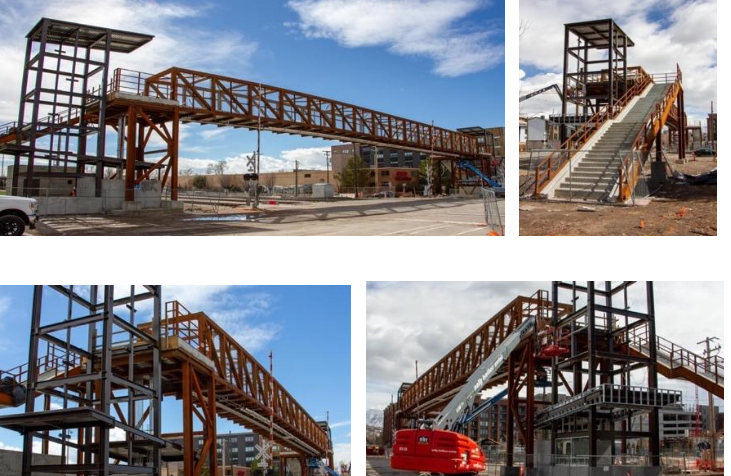
SETL Bridge is a new kind of half-through permanent compact panel bridge, with the span length from 35m to 81m; Carriage way is 4.2m of single lane or 7.35m of double lane. The bridge deck can be adopted steel plate and concrete, the concrete deck is more suitable for the permanent bridge, The bridge is composed by main girder, deck system and support system. The upper chord and nether chord of the main panel is modularized unit with a section of H shape. Web plate is modularized unit with a section of K shape. The bridge is connected up by the high strong bolts. SETL bridge has the advantages of long fatigue life, great loading capability and good appearance, suits to be used as a permanent bridge

Steel Arch Bridge
A single-span structure consisting of steel arches and a suspended deck having the form of a reinforced concrete composite slab integrated with steel crossbars. The primary structural components of the bridge are two hinge-less arches set on bearings resting on reinforced concrete abutments.
The arches are tensioned by tie beams suspended from the arches using hangers, and those tie beams also support the deck. The analysis of the structure of the bridge enabled the selection and optimisation of the sections and consideration of the interaction resulting from the integration of the deck with the steel crossbars. An important issue was how to ensure that the structure has the correct, linear shape after and during erection. Keywords: Road bridge, steel arch with tie-beam, suspended reinforced concrete slab, composite slab with steel crossbars.

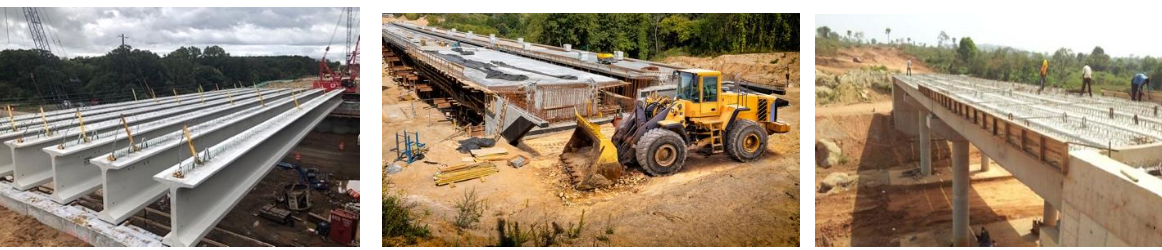
SETL precast girder bridge workflow offers a comprehensive and efficient solution for designing, analyzing, and detailing precast girder bridges. This innovative platform integrates advanced modeling, powerful structural analysis, and seamless automation to simplify complex processes while ensuring precision at every stage.

Bridges form the backbone of transportation infrastructure, connecting communities and enabling commerce. Among the various types of bridges, concrete girder bridges stand out as one of the most widely used bridge types globally, with some countries specifying standard concrete I-girders specifically for bridge use. Their popularity stems from a combination of cost-effectiveness, structural reliability, and ease of construction.
Precast girder bridge workflow offers a game-changing approach, simplifying and accelerating the design process while addressing the complexities of modern bridge construction.
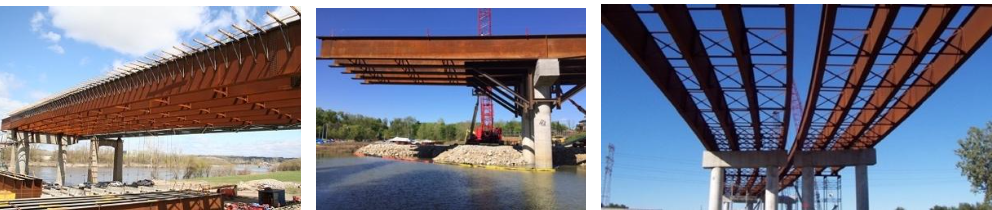
Girder bridges are the simplest bridge type in structure and consist of steel beams shaped to an I-section or box section, called a plate girder bridge or a box girder bridge, respectively. Girder bridges are comprised of deck slabs, on which vehicles and people pass, and of main girders supporting the deck slabs. Girders are large horizontal beams that act as the primary support for a building, to which all other smaller beams are connected, forming the structure’s “skeleton.” That’s the easiest way to picture the difference: girders are oversized beams.

Girder bridges are most commonly used for straight bridges that are 33-650 feet (10-200 m) long, such as light rail bridges, pedestrian overpasses, or highway fly-overs.